


Photonic Doppler Velocimetry (PDV)
Accurate velocity measurement of fast-moving materials is critical for many areas of scientific research and engineering, including shock physics, impact testing, and the study of material behavior under high pressures and extreme strain rates.
Photon Doppler Velocimetry (PDV) is a laser-based measurement technique that determines the velocity of a moving surface by analyzing the Doppler frequency shift of reflected light. It is widely used in high-speed dynamic experiments to capture precise, time-resolved velocity profiles of rapidly moving objects.
Quantifi Photonics provides the key optical instrumentation required to build reliable and repeatable PDV systems, from simple single-channel setups to complex multi-channel measurement platforms. Our modular solutions enable scalable system architectures while delivering the performance needed for demanding PDV applications.
Simplify your test bench
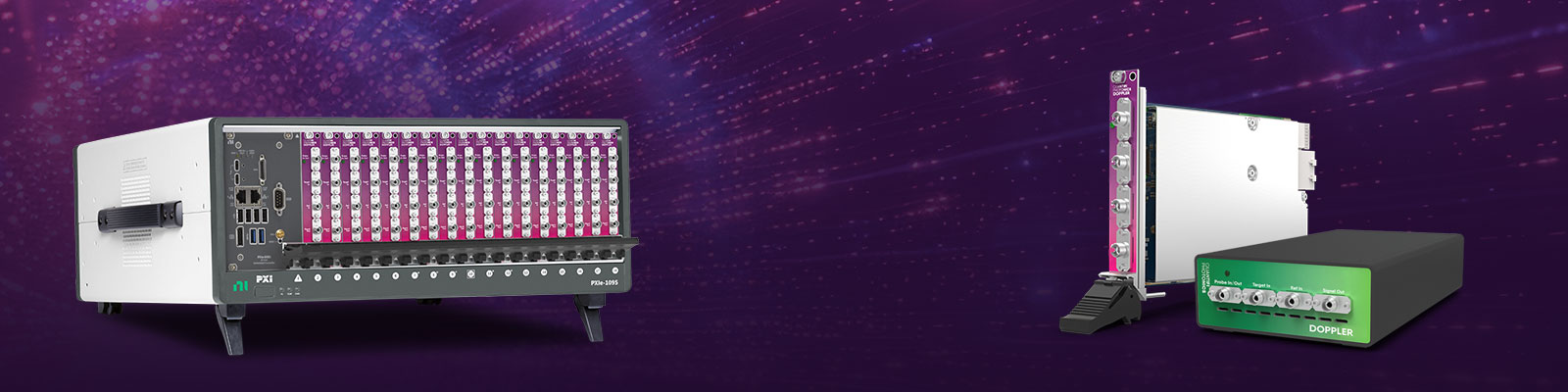
The Quantifi Photonics Doppler module combines key optical components and can be used with the Laser and O2E modules to build a streamlined PDV test system. The Doppler modules supports traditional homodyne and frequency-shifted heterodyne PDV testing.
Our instruments are available in a PXI module for multi-channel systems, or standalone benchtop instrument suited to single-channel or low-channel count systems. Optical probes and a digitizer or oscilloscope with suitable bandwidth and channels from 3rd party suppliers will round out the complete PDV test system.


This diagram shows the configuration of the Doppler 1001. It incorporates many of the key
optical components required to accurately condition the target and the reference laser and to mix the probe with the reference.
Build compact & scalable PDV systems
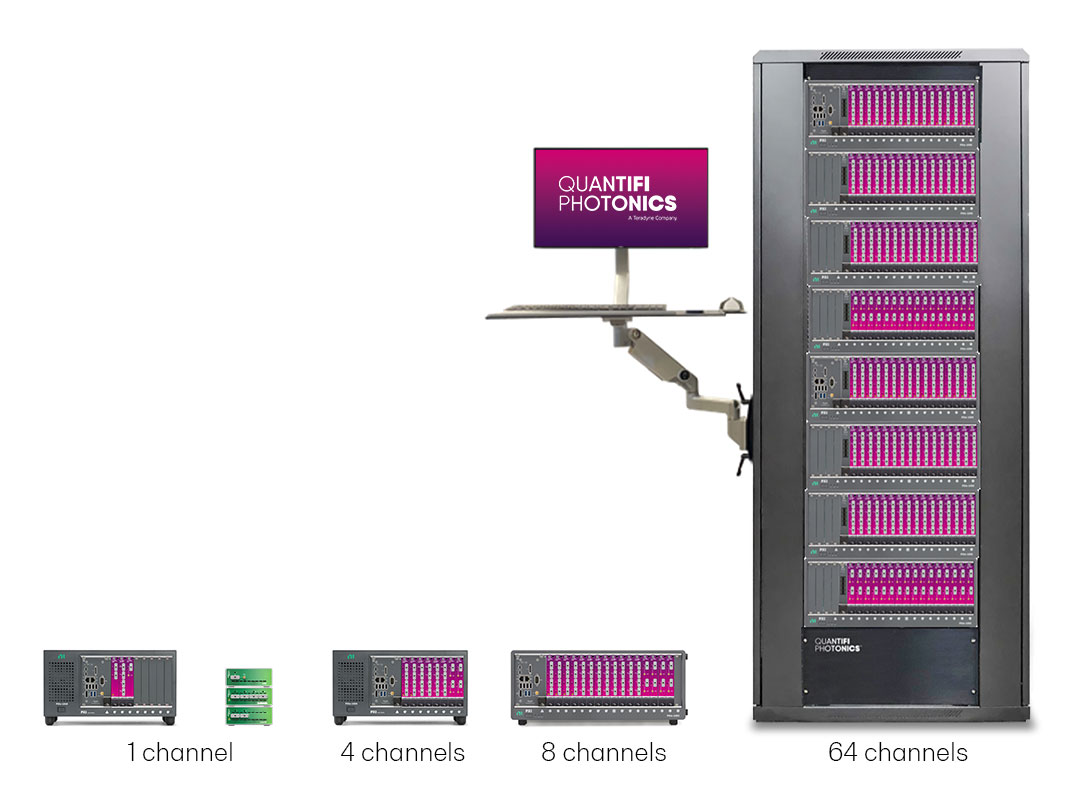
The diagram illustrates 1-, 4-, 8-, and 64-channel PDV measurement configurations. Each setup comprises Laser-1002 tunable laser sources (target and reference), Doppler-1001 modules, and O2E-1000 optical-to-electrical converter modules. Multiple PXI chassis can be daisy-chained to scale the system to higher channel counts as required.
The output from each Doppler-1001 module is connected to a high-channel-count, high-bandwidth O2E-1000 optical-to-electrical converter, where the probe and reference laser signals are combined to generate an optical beat signal. This beat signal is converted to the electrical domain and then captured using a suitably specified digitizer or oscilloscope with the required bandwidth and channel count (not shown).
Need help sizing your PDV system or selecting the right configuration?
Learn more
CASE STUDY
Manhattan College Chooses PXI-Based Solution from Quantifi Photonics to Simplify PDV System Design & Maintenance.

From working with many customers on a wide range of PDV applications, we have compiled a list of Frequently Asked Questions covering PDV techniques and instrument selection.
Manhattan College uses Quantifi Photonics’ modular PXI-based PDV instrumentation to reduce system design and setup time, and streamline system control with single software user interface.
APPLICATION NOTE
Photonic Doppler Velocimetry: Principles and Equipment for High-Precision Velocity Measurement

Photonic Doppler Velocimetry (PDV) is vital for measuring the velocity of fast-moving materials, key in fields like shock physics and high-pressure material studies. Recent telecommunications advancements have made PDV systems more compact, cost-effective, and robust. This application note explains the principles behind PDV and highlights the equipment our company offers to build advanced PDV test systems.
FREQUENTLY ASKED QUESTIONS

From working with many customers on a wide range of PDV applications, we have compiled a list of Frequently Asked Questions covering PDV techniques and instrument selection.


